
Does anyone remember playing Neopets? Neopets had certain activities you could only do once a day, so I would always go through the list of my “dailies” right after logging in. Most of the daily rewards were small, but getting them every day would help them build up into something more substantial.

When I moved to second grade from fourth grade, I started instituting some “dailies” This year, I have added even more. Each daily provides unique benefits for my students, but I also love how dailies themselves bring a sense of stability and rhythm. There’s a chance that this year could swing back and forth between being online and being in person, so having the same dailies in both formats will help the students have a sense of consistency.
Here are the dailies I am doing with my class this year:
MORNING MEETING
Morning meeting is a pretty common way to start the day in lower elementary classes. I use mine to help students get oriented to the day and to help them feel welcomed into the class. I start by having the students sing the days of the week and months of the year, doing a special hand motion when we get to that day’s day/month. We sing a good morning song and say a class affirmation (I am loved, I am proud of myself, I will make today the best day of all, etc.). Each day, I ask my students a question about themselves and give them a chance to answer, either in the big group or in a smaller group. We go over the agenda for the day, and we say a prayer. I love how Morning Meeting gives my students a chance to be involved and feel seen right at the beginning of the day, and it even helps me to remember what day of the week it is and what we have planned for the day!
ALPHABET CHANT
I start every reading class with an “Alphabet Chant.” I learned this from my co-teacher, Becca, who has been teaching grade 2 longer than I’ve been teaching at all! By second grade, the students should know the alphabet, but the Alphabet Chant is also a reminder of the sounds that go with each letter. For students learning a new language with a different alphabet, this is good daily practice. The alphabet chant starts, “A for alligator /a/ /a/ /a/, B for ball /b/ /b/ /b/…” and goes through the whole alphabet with motions for each letter. Later in the year, we will add vowel and consonant digraphs to the Alphabet Chant to help students remember those, too. Now I just need someone to make an Alphabet Chant for me to learn the Thai characters…
NUMBER TALK
A Number Talk is a way for students to describe how they approach problems and try out different strategies. The focus is less on getting the correct answer and more on explaining the solving process. One of my favorite Number Talk activities is to give my students a “Which One Doesn’t Belong?” image and have them defend their answers. Here’s a sample “Which One Doesn’t Belong?” from wodb.ca that I used with my class a couple weeks ago:
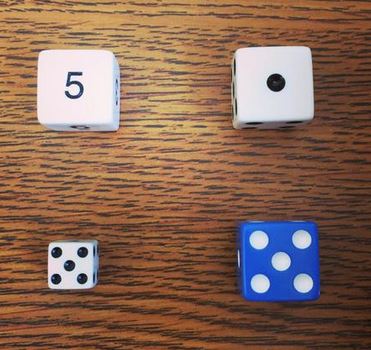
Which one do you think doesn’t belong? An argument can be made that any one of them is the odd one out. This helps my students refine their reasoning skills and practice listening to others’ opinions. Many of our other Number Talks give students a chance to practice addition strategies. While I want them to become fluent in addition and subtraction this year, I think that daily practice with different strategies will be more helpful in the long run than daily speed drills and memorization. Our Number Talks are a collaborative way to find different strategies to solve the same problem.
If you would like a sample week of any of my dailies, you can send me a message on the “Contact Us” page. It’s easier to start these practices when you have a model to adapt.
 mind-the-gap.blog